

Sorghum-Sudangrass (SS) is a powerhouse for first-year biomass production, but the real risk can show up in the crop that follows. In fact, a broad meta-analysis by Zhang et al. in 2021 indicated that allelopathy can cause an average 25% reduction in the performance of a subsequent crop. For a sensitive crop like spring canola, that translates directly to a 25% drop in expected revenue, and that’s before you factor in the other Northern Ontario realities that can amplify the problem.
That effect is called Allelopathy, which is the biological phenomenon where plants release chemical substances into the soil to suppress surrounding or subsequent crops. In Northern Ontario conditions, suppression risk is often driven by a combination of factors, including root exudates/secretions, heavy stover, slower residue breakdown, cooler soils, and short-term nutrient tie-up, which can quietly derail your next sensitive crop, like spring canola, under unmanaged conditions.
In our 2025 Northern Ontario trials, we tested how SS residue impacts the establishment and yield of subsequent small, seeded crops. The results are clear: planting into heavy SS residue without a management plan represents a major rotational risk in high-risk environments like ours.
Here are four specific rotational mistakes to avoid, helping you protect your yields and your bottom line.
Mistake 1: Pushing Seeding Rates Too High Without a Mitigation Plan
Many growers assume that planting more seed automatically guarantees higher yields, more palatable forage and higher returns. When it comes to Sorghum-Sudangrass, this is a dangerous assumption. Pushing your seeding rates up to 80 or 90 kg/ha (about 71 or 80 lb/ac) creates a massive residue and chemical load that actively works against your next crop.
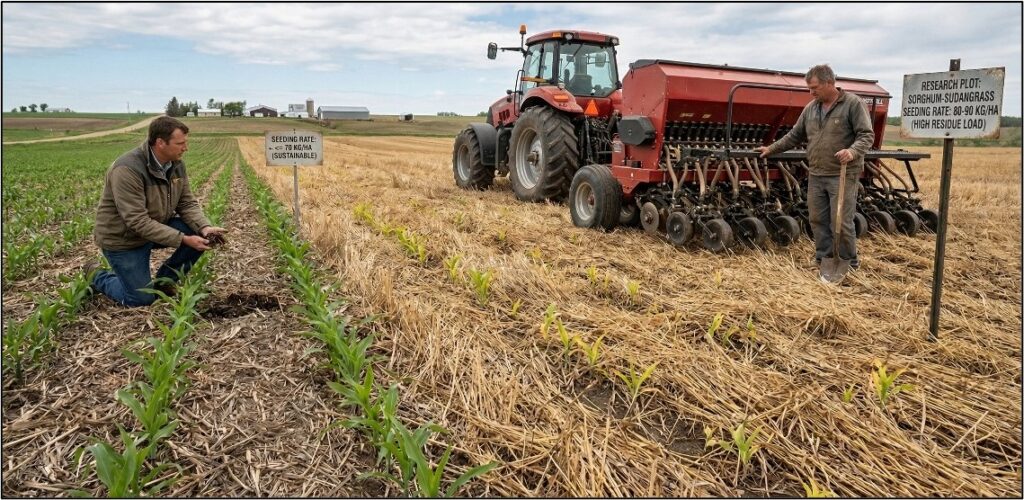
Here is what the data from our Rainy River trial site reveals:
The Dose-Response Yield Drop: As SS seeding rates increased from 45 to 90 kg/ha (about 40 to 80 lb/ac), the mean yield of the following canola crop dropped steadily, and our analysis showed the difference between treatments was real.
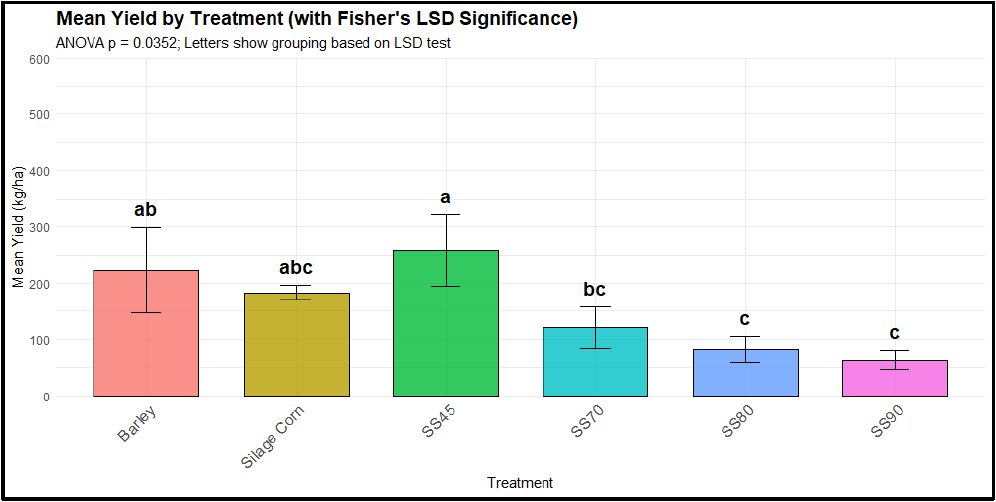
The Threshold of Failure: The highest seeding rate (SS90) produced the lowest overall canola yield. The heavy residue released high concentrations of crop-inhibiting compounds (sorgoleone) into the soil, severely inhibiting canola as shown in Figure 2.
The False Economy: Even when SS yields are higher, it can still lose money as seen on Table 1. While sites like Algoma saw continuous yield gains in year 1 up to 90 kg/ha, locations like Rainy River and Thunder Bay almost plateaued after 70 kg/ha. Even where yields remained higher than lower seeding rates, the jump in harvest and storage costs erased the benefits. When yield-scaled costs were applied, SS produced negative gross margins across every site and seeding rate.
Mistake 2: Treating All Soils and Climates the Same
Allelopathic suppression is not a uniform penalty. The risk depends entirely on how fast your local soil breaks down the crop residue. If you treat a cool and wet field the same as a warm and biologically active one, you are gambling with your crop establishment.
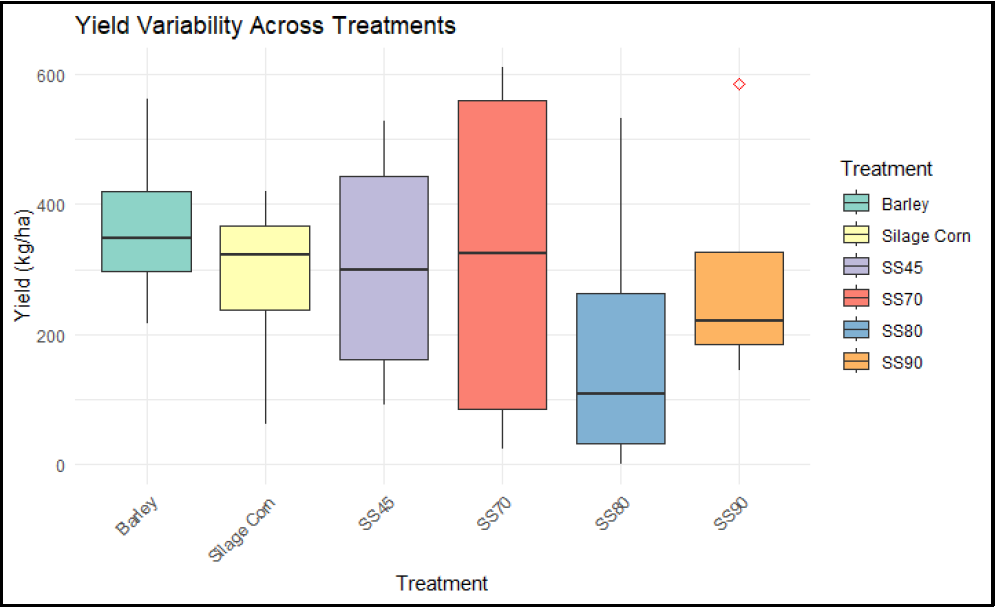
The Cold Weather Penalty: In Algoma, cooler and wetter conditions slowed residue decomposition. At high seeding rates of 70 to 90 kg/ha (about 62 to 80 lb/ac), this caused extreme yield variability, with results swinging by 59% to 111%, meaning that outcomes were highly unreliable and could range from acceptable stands to near crop failure. This unpredictability resulted in near-total crop failures in some specific replications as shown in the figure below.
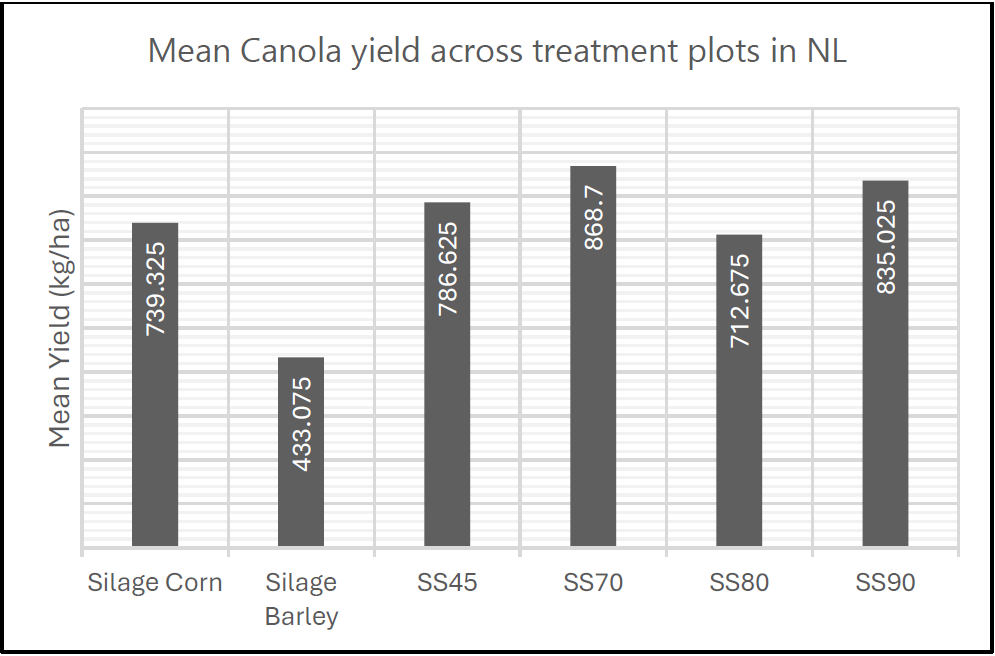
The Organic Matter Advantage: On the other hand, the New Liskeard site experienced no significant suppression. The soil there warmed more quickly and had a much higher organic matter content of 7.1% than the other sites studied. These conditions helped the soil break down the sorgoleone compounds quickly, before they could harm the canola as shown in the bar chart below.
Mistake 3: Skipping Tillage in Heavy Stover
In high-residue situations, leaving Sorghum-Sudangrass residue on the soil surface can trap toxins exactly where your new seed needs to grow. Active residue management is critical when dealing with high biomass.
The No-Till Trap: Canola at all sites apart from TB were planted into stover under no till conditions. At the Rainy River site, the relatively dry conditions slowed the breakdown of allelochemicals. This concentrated the toxins in the upper soil layers and severely suppressed the subsequent yield.
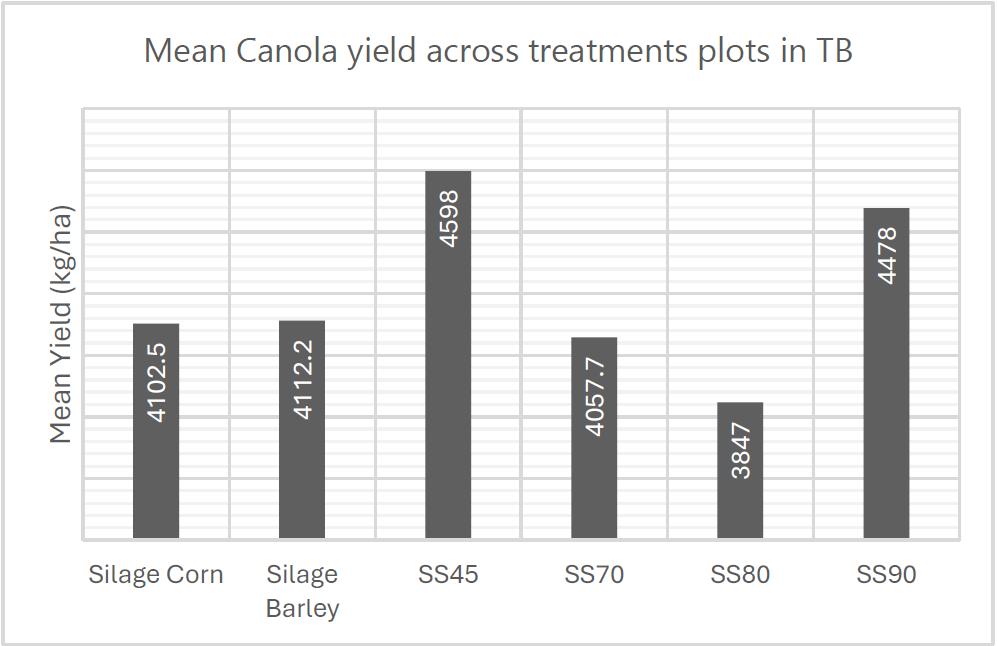
The Tillage Boost: Thunder Bay took a different approach by rototilling the plots before seeding. For the highest residue treatment of 90 kg/ha (about 80 lb/ac), this tillage accelerated the breakdown of toxins and triggered a release of trapped nutrients like Phosphorus and Potassium back into the soil. This created a “bio-fertilization effect” that boosted the canola yield to an impressive 4,478 kg/ha (about 3,995 lb/ac).
Mistake 4: Ignoring the Hidden “Rotational Penalty”
When calculating the Return on Investment (ROI) for your forage crops, you cannot stop at the end of year one. Ignoring the carry-over effects of Sorghum-Sudangrass (SS) provides a false sense of profitability.
A true economic assessment must account for the potential rotational penalty inflicted on your next crop.
The 25% Yield Drop: A broad meta-analysis by Zhang et al. in 2021 indicated that allelopathy can cause an average 25% reduction in the performance of a subsequent crop. For a sensitive crop like spring canola, this translates directly to a 25% drop in expected revenue.
The True Gross Margin: You must add this expected revenue loss to your year one operating costs. When you combine the negative gross margins (see table 1) of high-density SS with a 25% yield penalty on your cash crop, the SS-canola sequence becomes economically unattractive.
Why SS costs more than it earns
Reading tip: negative gross margins are losses where the costs were higher than revenue.
| Site | Crop | Gross revenue ($/ac) | Operating costs ($/ac) | Gross margin ($/ac) |
| Rainy River | Silage barley | 84.80 | 595.10 | -510.30 |
| SS45-SS90 | 464.10–629.00 | 1051.85–1,301.21 | -815.52 to -587.75 | |
| Thunder Bay | Silage barley | 750.00 | 595.10 | 154.90 |
| SS45-SS90 | 222.70–345.10 | 1,051.85-1424.57 | -1,118.57 to -829.15 | |
| Algoma | Silage barley | 542.00 | 595.10 | -53.10 |
| SS45-SS90 | 321.30–697.00 | 1051.85-1805.21 | -1,225.07 to -730.55 | |
| New Liskeard | Silage barley | 306.00 | 595.10 | -289.10 |
| SS45-SS90 | 215.90–374.00 | 1051.85–1,325.00 | -1,105.36 to -774.75 |
Strategic Forage Planning
In summary, the impact of SS on subsequent crops in Northern Ontario is not always uniform as the allelopathic risk varies depending on conditions. Notably, greater SS biomass does not always result in reduced yields for following crops. SS continues to be a valuable option as a rescue forage or short-term solution when other forage crops fall short. To safeguard your farm’s profitability, it’s essential to combine higher seeding rates with proactive residue management and strategic crop rotation planning.
Ready to protect your yields? If you had SS last year, go into your next crop with a residue plan, manage heavy stover (and consider tillage where residue is thick) before seeding a sensitive crop like spring canola. If you’re planning SS this year, avoid pushing seeding rates to the highest levels unless you also plan how you’ll manage the residue and what crop will follow.
About the Research Team
This research initiative was led by the Rural Agri-Innovation Network (RAIN) with the objective of assisting Northern Ontario farmers in optimizing forage rotations and safeguarding their financial sustainability. To ensure the data collected is both locally relevant and scientifically robust, RAIN collaborated closely with the University of Guelph and regional Ontario Crop Research Stations, including New Liskeard, Rainy River, and LUARS.